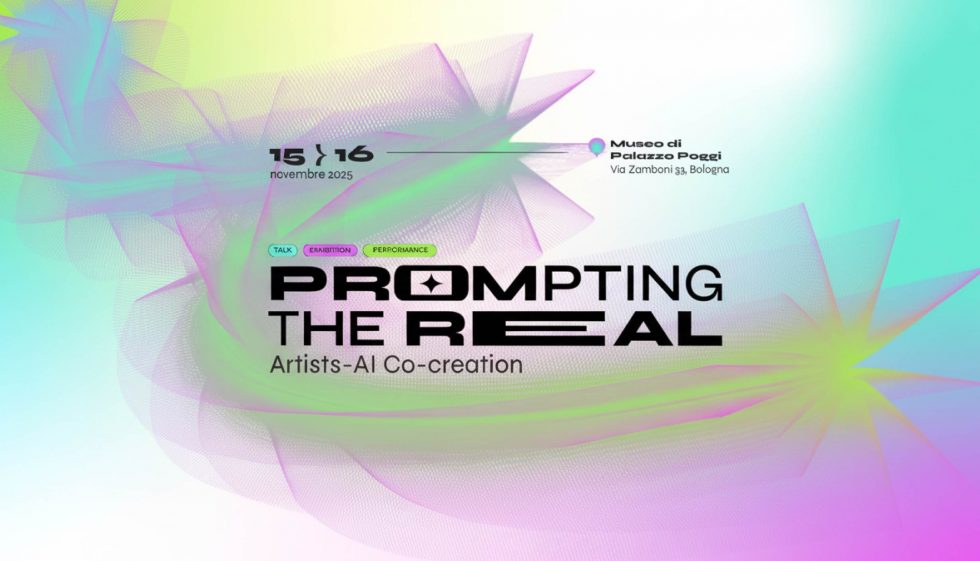
Sculptures, performances, poetry, music, dance, video, and photography reveal how much and in what ways reality is already mediated by artificial intelligence. This is the aim of the exhibition “Prompting the Real – Artists-AI co-creation,” held on Saturday, November 15, and Sunday, November 16, at the Palazzo Poggi Museum, under the patronage of the FAIR Foundation, hub of the extended PNRR Partnership, which aims to advance research related to artificial intelligence.
Organized by the Department of Computer Science, Science, and Engineering (DISI), the Alma Mater Research Institute for Human-Centered Artificial Intelligence (ALMA-AI), and the University of Bologna Museum System in collaboration with ICSC – National Research Center in HPC, Big Data and Quantum Computing, and the National Institute of Nuclear Physics (INFN), the exhibition explores what AI already does: its potential and its limits, what imaginaries it activates, what structures it replicates, what forms of power it conceals or reveals.
The exhibition
The exhibition, curated by Sineglossa, a cultural organization active in the production of artistic projects and events dedicated to the relationship between humans and artificial intelligence, interacts with the Museum’s permanent collection through works that transform abstract concepts into tangible forms and act as devices for experience and sensory totems. In this context, artificial intelligence becomes a tool for reinterpreting the museum’s heritage, activating a comparison between the history of science and possible futures.
While for machines a prompt is a command, here the perspective is reversed: ‘prompting the real’ becomes a creative and critical gesture by artists to question humanity’s relationship with artificial intelligence. Thus, through art, AI ceases to be an abstract concept and concretely reveals its complex relationship with society.
AI War Cloud Database
Sarah Ciston’s AI War Cloud Database (winner of the STARTS 2025 Award) reveals military infrastructures and automated decision-making systems, reminding us that every algorithm is a political act inscribed in a network of power, technology, and material consequences.
Silent Hero
At the same time, Alexey Yurenev’s Silent Hero uses artificial intelligence to investigate fragmented family memories and demolish the heroic rhetoric of war: a generative neural network, trained with thousands of portraits of soldiers, produces disturbing and distorted human faces. An attempt to make visible what has been excluded from the official narrative.
Water Clocks
In “Water Clocks,” Roberto Pugliese translates climate change data, processed by CINECA’s supercomputing, into sounds and fluid movements that make the slow advance of the global environmental crisis audible. The sound changes according to the data analyzed, allowing us to perceive slow and profound transformations that normally escape our senses.
I Am Code
Poetry takes center stage with the vocal installation “I Am Code” by Brent Katz, Josh Morgenthau, and Simon Rich. A form of generative writing that, through the voice of Werner Herzog (Golden Lion for Lifetime Achievement – Venice Biennale 2025), explores the limits of generative language and questions the boundary between structure and meaning, between human author and algorithmic process.
Cloud Gazing
In Damien Roach‘s work Cloud Gazing, object recognition algorithms go into cognitive overdrive as they attempt to interpret ever-changing clouds, ultimately “seeing” what remains invisible to the human eye. What latent potentialities can we bring to light by hacking the computational systems that shape our reality, subverting their intended use, implicit policies, and power structures?
Machines for disobedient dialogues
Michele Cremaschi explores the relationship between language and machines with “Macchine per dialoghi disobbedienti” (Machines for Disobedient Dialogues): Isotta, a vintage typewriter connected to a digital interface that simulates Twitter, and Alessia, which integrates a Large Language Model with a 1960s reel-to-reel tape recorder, bring to life with irony and precision the encounter between artificial intelligence and obsolete media.
Dear Chatbot
Equally ironic is “Dear Chatbot,” Silvia Galletti’s performance in which a choreography develops in real time thanks to the interaction between the performer, the audience, and the chatbot Charlie, who acts as a guide, obstacle, and provocation.
The Prompt
“The Prompt,” a short animated film written and directed by Francesco Frisari, tells the story of a predicted apocalypse, revealing the paradox of a technology that replicates our own fears: we imagined apocalyptic futures in which machines would dominate us, and we trained them with this content. Now they can do nothing but reproduce them. Produced by Fantomatica.ai, with the support of AIxIA and Rai Cinema, “The Prompt” takes viewers into an “uncanny valley,” where AIs are figures as spectral as they are digital, to develop the theme of the “ghost in the machine.”
AI Messages and Deeptime
Jerry Galle, on the other hand, constructs imaginary archives and future artifacts in an archaeological science fiction with “AI Messages” and “Deeptime”: timeless objects that do not bear witness to the past, but suggest possible futures. Not archives of what has been, but clues to alternative realities, where memory is no longer reconstruction, but fabricated hypothesis.
Events and Museum
Alongside the exhibition, over the course of the two days, there will also be a series of events open to everyone (reservation required, subject to availability): the award ceremony and screening of the winning videos from the ALMA-AI Video Contest 2025, produced by the University’s student community (at 10 a.m. on Saturday 15); Dear Chatbot, a performance by Silvia Galletti who, together with the audience, dialogues with Charlie, a chatbot trained in choreographic composition (at 12 p.m. and 5:30 p.m. on Saturday and at 12:15 p.m. and 4 p.m. on Sunday); meetings with the artists (Saturday at 4 p.m. and Sunday at 4:45 p.m.); musical improvisation with AI, a talk followed by a performance exploring the interaction between music, artificial intelligence, and virtual reality, based on the research results of the FAIR-PNRR project on human creativity in immersive and multisensory environments, with researcher Aldo Gangemi and researchers Chiara Lucifora and Claudia Scorolli from the University of Bologna and musicians Canio Coscia, Francesco Milone, and Sergio Mariotti (at 11 a.m. on Sunday).
PALAZZO POGGI MUSEUM
Via Zamboni 33, Bologna NOVEMBER 15 and 16
Opening hours: 10 a.m. to 6 p.m.
Free admission – Reservations required to participate in scheduled events