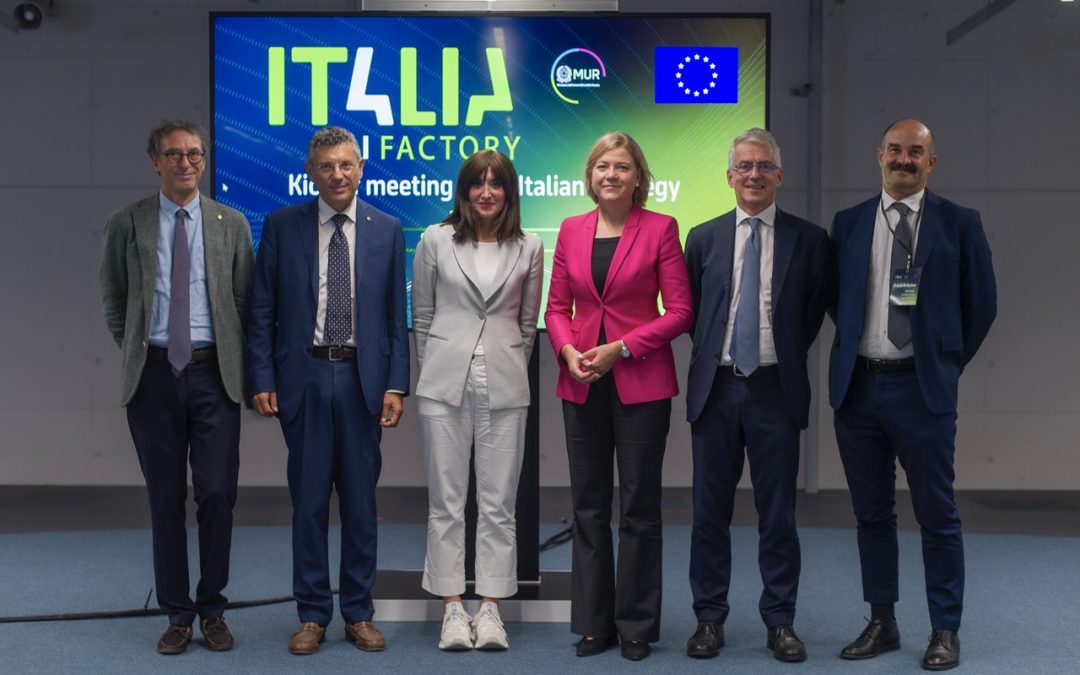
Rome, 24 October 2025 – The Observatory on Supercomputing Trends and Applications, a project of the ICSC – National Research Centre for High Performance Computing, Big Data and Quantum Computing, created and managed by IFAB – International Foundation Big Data and Artificial Intelligence for Human Development, today presented in Rome the results of the new report ‘What policies for strategic technologies in the 21st century?’ developed in collaboration with the ASTRID Foundation’s Observatory on the dynamics of artificial intelligence. This strategic document is part of the activities of the ICSC National Centre, whose main objective, namely to promote innovation and competitiveness in the country by providing it with a supercomputing cloud infrastructure and the necessary skills, is also pursued through the analysis of the social, economic and regulatory impact of emerging technologies and the development of recommendations aimed at supporting the work of policy makers.
The initiative brought together institutions, experts and representatives from academia and industry (https://osservatorio. supercomputing-icsc.it/eventi/quali-policy-per-le-tecnologie-strategiche-del-xii-secolo-roma-24-ottobre-2025/) to discuss the policy priorities needed to ensure that Italy and Europe remain competitive in the development of emerging technologies – from supercomputing to artificial intelligence, quantum computing to digital sustainability.
Purpose and structure of the report
The recommendations set out in the Report highlight the importance of targeted strategic action to support the digital competitiveness of Italy and its SMEs (but also medium-large enterprises), ensuring that the country can fully benefit from technological innovation.
The digital transition represents a challenge, but also an opportunity, to relaunch the national production system on a territorial basis and ensure a more resilient and innovative future.
In developing policy recommendations, four key categories were analysed for the digital transformation and economic competitiveness of SMEs: digital strategy, Big Data, High-Performance Computing (HPC) and Cloud. Support policies in these areas can reduce the technology gap, promote innovation and foster sustainable and inclusive economic growth.
What emerges from the analysis
This analysis highlights a number of areas where public intervention is needed in the Italian digital ecosystem.
Firstly, national regulations need to be harmonised with the European framework, avoiding further complexity in compliance with digital regulations. The desired path is one of regulatory simplification, coordination between the various sectoral texts and a national focus on implementation, with local policies for SMEs.
Regulation is linked to the design of an industrial policy for the digital ecosystem, which must take shape quickly. A long-term plan based on a systemic vision needs to be defined, with a specific focus on semiconductors, physical infrastructure (connectivity networks, data centres) and virtual infrastructure (primarily the cloud), as well as platform interoperability.
It is also desirable to reduce dependence on US and Asian hardware, where possible, with specific initiatives that continue to support this commitment.
Regulation and industrial policy must also be accompanied by what are known as context measures. These include the need for increased investment in STEM education (both in schools and in the reskilling and upskilling of workers), collaboration between businesses and the public sector, action on energy costs and a review of grid connection procedures.
The contribution of promoters and experts
‘We are committed to creating ecosystems of innovation focused on public-private cooperation models that connect universities and research centres with SMEs. The path to digital development in our country must be collaborative and shared, fuelled by dedicated legislative and industrial initiatives,’ says Marco Becca, Director General of IFAB.
“The report presented today is a valuable contribution to the ICSC National Centre and is fully consistent with the path initiated by the Ministry of University and Research, through the PNRR, to build a solid national infrastructure for supercomputing and quantum computing. This infrastructure is the technological heart on which the digital autonomy, innovation and competitiveness of the country and its businesses are based. In order for it to reach its full potential, it must be accompanied by targeted actions aimed at strengthening public-private collaboration, facilitating access to complex infrastructure, supporting training and skills development, and simplifying administrative and reporting processes to facilitate easier access to funding. In this perspective, the joint work of the ICSC Observatory with Astrid represents a significant step towards translating the vision into concrete proposals for an open, collaborative and future-oriented ecosystem,’ adds Daniela Gabellini, Director General of the IC National Centre.
“The digital transition has accelerated thanks to advances in supercomputing, cloud computing and artificial intelligence, above all. In order to define effective policy measures, the following are necessary first and foremost: a systemic view of the entire digital supply chain, not limited to individual components, and clear integration between European and national policies,” concludes Antonio Perrucci, Director of ASTRID-LED.
Future scenarios and Italy's role
Italy has already begun to follow the path outlined in the Report.
The government is promoting specific initiatives for an Italian strategy for artificial intelligence, as well as for the cloud, while a new Italian strategy for ultra-broadband networks has been launched.
It is very important that local areas also benefit from this development. In this context, it is important to strengthen local HPC and cloud infrastructures, allowing more widespread and easier access for businesses, as well as supporting the transition to Edge Computing models to improve security, data localisation and technological autonomy.
In order to promote better conditions for the development of SMEs, it also appears necessary to guarantee access to advanced computing infrastructure through federated AI models and EuroHPC platforms open to this type of company; to encourage the development of specialist skills in order to promote the adoption of digital technologies in local production chains; and to simplify access to national and European funds dedicated to digital transformation, reducing bureaucratic burdens and offering tailor-made financial instruments.